
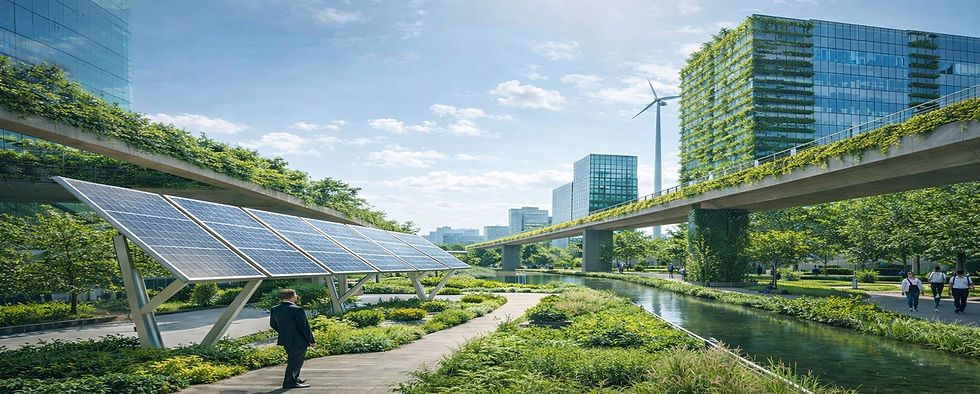
Building a Sustainable Future
At HEFI, sustainability is at the heart of everything we do.
Our approach integrates Environmental, Social and Economic
responsibilities to ensure long-term positive impact and resilient development for future generations.


Our commitment is to create lasting value by balancing environmental stewardship, social responsibility, and sustainable economic growth.

Collaborating for Impact
By collaborating with communities, partners, and stakeholders, HEFI ensures that our initiatives create shared value, uplift lives and contribute to a more inclusive, sustainable and prosperous world.
Driving Sustainable Solutions
HEFI is committed to driving sustainable solutions that harmonize growth with environmental stewardship. We integrate advanced science, engineering excellence and innovative technologies to address today's challenges and build a resilient future.



🌱 Sustainability in Action:
We drive innovation that unites planet, people, and prosperity to build a resilient and sustainable future.
At HEFI Group, we explore sustainability through best management practices in applied science and engineering. We highlight lessons learned and practical approaches to advance sustainable development—creating solutions that balance innovation, progress, and environmental responsibility for a more resilient world. We believe that true sustainability exists at the intersection of three pillars: environmental, social, and economic. Ignoring one leads to imbalance—for example, economic growth without environmental care causes resource depletion, while environmental protection without social equity leaves communities vulnerable. That’s why we champion integrated strategies that balance planet, people, and prosperity.
The core pillars of sustainability are Environmental, Social, and Economic — often summarized as “Planet, People, and Profit.” These three dimensions form the foundation of sustainable development, ensuring that progress balances ecological health, human well-being, and long-term economic viability.

Environmental Sustainability (Planet)
• Focuses on protecting ecosystems, biodiversity, and natural resources.
• Key practices: pollution control, renewable energy adoption, climate change mitigation, and responsible resource use.
• Why it matters: Without a healthy environment, social and economic systems collapse.

Social Sustainability (People)
• Ensures equity, inclusion, and quality of life for all communities.
• Key practices: access to education and healthcare, gender equality, labor rights, community participation, and cultural preservation.
• Why it matters: Development must uplift people, reduce inequality, and protect human rights.

Economic Sustainability (Profit/Prosperity)
• Promotes stable, inclusive, and resource-efficient growth.
• Key practices: long-term financial resilience, innovation, and balancing profitability with environmental and social responsibility.
• Why it matters: Economic systems must support livelihoods without undermining society or the environment.